The Problem
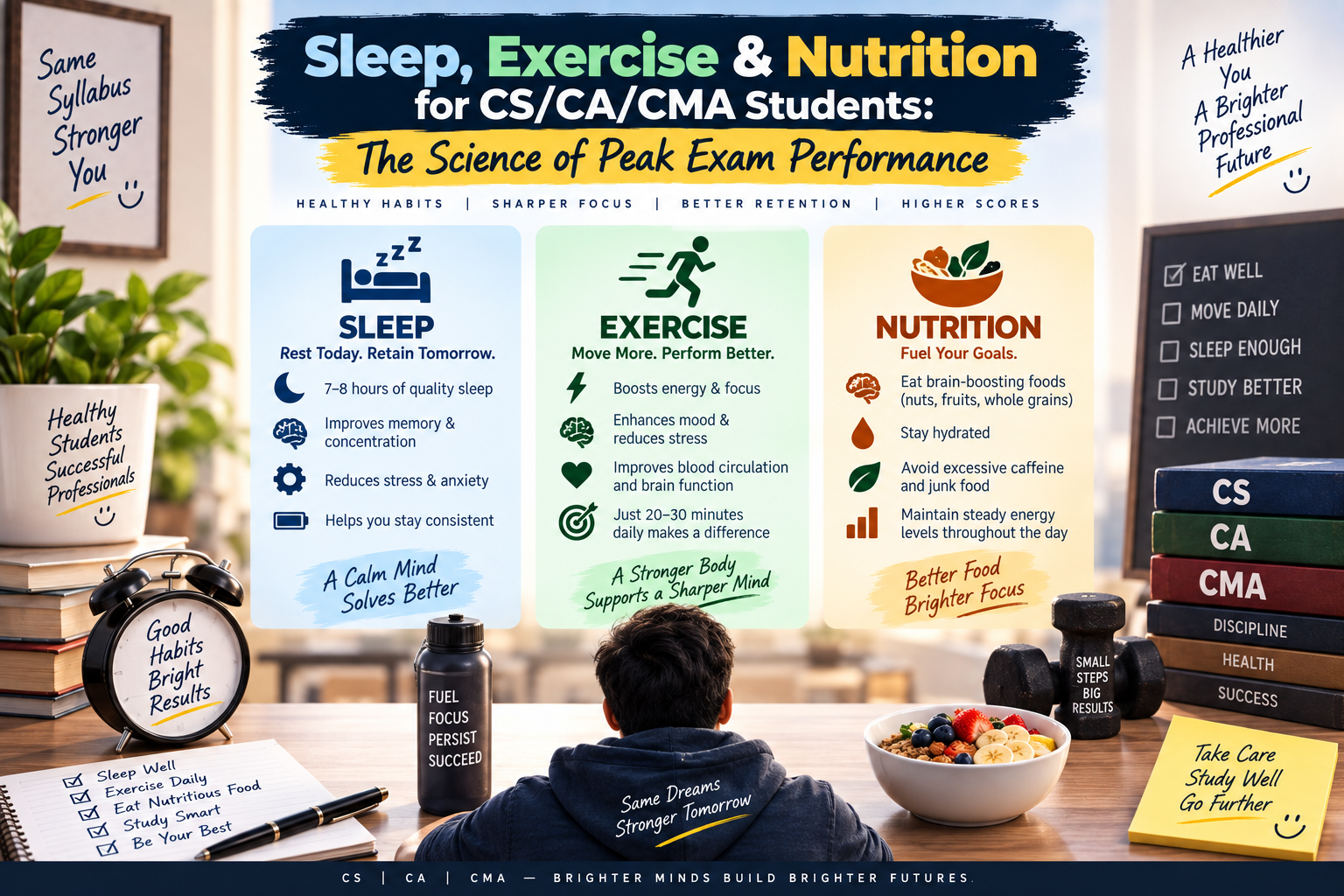
Students cut sleep to study more. Skip exercise to save time. Eat whatever is convenient. Then wonder why they can't focus, why memory feels foggy, why they're making stupid mistakes. Your brain is a biological organ — and you're running it on empty.
Students cut sleep to study more. Skip exercise to save time. Eat whatever is convenient. Then wonder why they can't focus, why memory feels foggy, why they're making stupid mistakes. Your brain is a biological organ — and you're running it on empty.
Sleep: The Most Underrated Study Tool
🔬 Sleep and Memory Consolidation
During sleep (specifically slow-wave and REM sleep), the brain replays and consolidates memories learned during the day — transferring them from short-term to long-term storage. Matthew Walker (UC Berkeley, "Why We Sleep") showed that students who sleep 7–8 hours after studying retain 40% more information than those who study the same amount but sleep only 6 hours. Pulling all-nighters before exams is neurologically catastrophic — it degrades exactly the memory you built over months.
During sleep (specifically slow-wave and REM sleep), the brain replays and consolidates memories learned during the day — transferring them from short-term to long-term storage. Matthew Walker (UC Berkeley, "Why We Sleep") showed that students who sleep 7–8 hours after studying retain 40% more information than those who study the same amount but sleep only 6 hours. Pulling all-nighters before exams is neurologically catastrophic — it degrades exactly the memory you built over months.
Sleep Principle 1: Consistency Beats Duration
Going to bed at the same time every night, even on weekends, produces better cognitive performance than irregular long sleeps. Your circadian rhythm thrives on consistency.
Going to bed at the same time every night, even on weekends, produces better cognitive performance than irregular long sleeps. Your circadian rhythm thrives on consistency.
Sleep Principle 2: 7–8 Hours is the Floor, Not the Ceiling
6 hours of sleep produces the same cognitive impairment as being drunk (blood alcohol 0.1%). And sleep-deprived people consistently underestimate their own impairment.
6 hours of sleep produces the same cognitive impairment as being drunk (blood alcohol 0.1%). And sleep-deprived people consistently underestimate their own impairment.
Sleep Principle 3: No Study After 10pm
Study done past 10pm rarely consolidates effectively — the quality of late-night learning is poor, and it delays sleep which undermines what you learned during the day. Stop at 10pm. Go to bed. Your morning session will be 3× more effective.
Study done past 10pm rarely consolidates effectively — the quality of late-night learning is poor, and it delays sleep which undermines what you learned during the day. Stop at 10pm. Go to bed. Your morning session will be 3× more effective.
Sleep Principle 4: The Night Before the Exam
Good sleep the night before matters more than any revision session. Your memory access is directly tied to your sleep state. A student who slept 8 hours outperforms a student who studied 3 extra hours instead of sleeping.
Good sleep the night before matters more than any revision session. Your memory access is directly tied to your sleep state. A student who slept 8 hours outperforms a student who studied 3 extra hours instead of sleeping.
Exercise: The Brain's Maintenance Protocol
🔬 Exercise and Neuroplasticity
Regular aerobic exercise increases BDNF (Brain-Derived Neurotrophic Factor) — a protein literally called "Miracle-Gro for the brain." BDNF promotes the growth of new neurons in the hippocampus (memory center) and significantly improves learning, retention, and stress resilience. John Ratey (Harvard, "Spark") showed that 20 minutes of aerobic exercise before studying improved test scores by 17%.
Regular aerobic exercise increases BDNF (Brain-Derived Neurotrophic Factor) — a protein literally called "Miracle-Gro for the brain." BDNF promotes the growth of new neurons in the hippocampus (memory center) and significantly improves learning, retention, and stress resilience. John Ratey (Harvard, "Spark") showed that 20 minutes of aerobic exercise before studying improved test scores by 17%.
Minimum effective dose: 20–30 minutes of moderate aerobic exercise (brisk walk, cycling, swimming) 5 days per week. This is not a luxury — it's maintenance for your primary study tool: your brain.
Nutrition: Fuel for the Exam Machine
💡 Brain-Optimized Nutrition
Breakfast (mandatory): Oats, eggs, banana, nuts — slow-release energy prevents mid-morning cognitive crashes
Study snacks: Walnuts (omega-3), dark chocolate (flavonoids, small amounts), blueberries (antioxidants), green tea (L-theanine + caffeine)
Hydration: Even 1–2% dehydration reduces cognitive performance by 10–15%. Keep water on desk at all times.
Avoid: Heavy meals before studying (blood diverted to digestion), excessive sugar (crashes), energy drinks past 3pm (sleep disruption)
Breakfast (mandatory): Oats, eggs, banana, nuts — slow-release energy prevents mid-morning cognitive crashes
Study snacks: Walnuts (omega-3), dark chocolate (flavonoids, small amounts), blueberries (antioxidants), green tea (L-theanine + caffeine)
Hydration: Even 1–2% dehydration reduces cognitive performance by 10–15%. Keep water on desk at all times.
Avoid: Heavy meals before studying (blood diverted to digestion), excessive sugar (crashes), energy drinks past 3pm (sleep disruption)
❌ Typical Exam Prep Lifestyle
- 5–6 hours sleep ("sacrifice for exams")
- No exercise ("waste of time")
- Irregular meals, lots of coffee
- Foggy focus, poor retention, anxiety
- All-nighter before exam
✅ High-Performance Lifestyle
- 7–8 hours consistently
- 20-30 min exercise daily (before study)
- Nutritious regular meals, water always
- Sharp focus, strong retention, calm confidence
- Early night before exam day
🎯 Start With One Change
Pick ONE: set a fixed 10:30pm bedtime for the next 7 days, OR add a 20-minute walk before your morning study session. Just one change. Track the impact on your focus quality. The results will make the second change obvious.
Pick ONE: set a fixed 10:30pm bedtime for the next 7 days, OR add a 20-minute walk before your morning study session. Just one change. Track the impact on your focus quality. The results will make the second change obvious.
- Fixed bedtime set and followed (10pm–10:30pm target)
- 7–8 hours sleep minimum every night
- 20–30 minutes exercise at least 5 days/week
- Breakfast daily before study
- Water bottle on desk throughout study sessions
- No heavy caffeine after 3pm
- No studying past 10pm
🔑 Key Takeaway
Sleep is not time stolen from studying — it's the time your brain converts studying into memory. Exercise is not separate from exam prep — it's brain maintenance. Nutrition is not secondary — it's fuel. Treat your body as the high-performance instrument it needs to be. Your exam results will reflect it.
Sleep is not time stolen from studying — it's the time your brain converts studying into memory. Exercise is not separate from exam prep — it's brain maintenance. Nutrition is not secondary — it's fuel. Treat your body as the high-performance instrument it needs to be. Your exam results will reflect it.
Past Paper Coverage: Where Marks Come From
Marks Contribution by Question Source — CA Final (Last 10 Papers)
Analysis of CA Final past 10 papers | marks weightage by topic recurrence
58% of marks come from topics that appear in over 50% of past papers. Mastering these high-frequency topics alone puts you on track for a pass. The remaining 42% comes from moderate and low-frequency areas — important for distinction, less critical for passing.
High-Frequency Topics: Company Law (CS Executive)
| Topic | Frequency (last 10 papers) | Typical Marks | Priority |
|---|---|---|---|
| Directors — Appointment, Removal, Duties | 9/10 papers | 8–16 marks | 🔴 Must Know |
| Board Meetings — Notice, Quorum, Minutes | 8/10 papers | 6–12 marks | 🔴 Must Know |
| AGM/EGM provisions | 8/10 papers | 8–16 marks | 🔴 Must Know |
| Related Party Transactions (S.188) | 7/10 papers | 6–10 marks | 🟡 High Priority |
| CSR (S.135) | 7/10 papers | 6–10 marks | 🟡 High Priority |
| Winding Up / Dissolution | 5/10 papers | 6–8 marks | 🟡 Moderate |
Past Paper Study Method: 3 Passes
How to Extract Maximum Value from Past Papers:
Pass 1 — Attempt under exam conditions. Set timer, no notes, write answers. Don't check solutions during attempt.
Pass 2 — Detailed analysis. After attempting, compare against model answers line by line. Mark each question: full marks available, marks you'd get, gap, reason for gap.
Pass 3 — Pattern identification. After 5 past papers, create your frequency table. Which topics appear every time? Which sections/formulas come up repeatedly? Your revision priority list comes entirely from this table, not from syllabus order.
Pass 1 — Attempt under exam conditions. Set timer, no notes, write answers. Don't check solutions during attempt.
Pass 2 — Detailed analysis. After attempting, compare against model answers line by line. Mark each question: full marks available, marks you'd get, gap, reason for gap.
Pass 3 — Pattern identification. After 5 past papers, create your frequency table. Which topics appear every time? Which sections/formulas come up repeatedly? Your revision priority list comes entirely from this table, not from syllabus order.
🎓 E-mentor's Past Paper Integration
E-mentor's question bank is built around past paper question types and frequently tested topics. The chapter tests are structured to replicate the question patterns from ICAI/ICMAI/ICSI past papers. After identifying your high-frequency topic list from past papers, focus your E-mentor practice on exactly those topics. Use E-mentor's subject-wise tests to simulate full paper conditions. The alignment between E-mentor's question bank and actual exam patterns means targeted E-mentor practice is effective preparation — not just generic study.
E-mentor's question bank is built around past paper question types and frequently tested topics. The chapter tests are structured to replicate the question patterns from ICAI/ICMAI/ICSI past papers. After identifying your high-frequency topic list from past papers, focus your E-mentor practice on exactly those topics. Use E-mentor's subject-wise tests to simulate full paper conditions. The alignment between E-mentor's question bank and actual exam patterns means targeted E-mentor practice is effective preparation — not just generic study.
