The Problem
30 days left. 6 papers. Months of notes to revise. Topics you haven't touched in weeks. Panic is the natural response. But the students who pass in this window aren't smarter — they have a better plan for these 30 days.
30 days left. 6 papers. Months of notes to revise. Topics you haven't touched in weeks. Panic is the natural response. But the students who pass in this window aren't smarter — they have a better plan for these 30 days.
The Physics of the Last 30 Days
You cannot learn everything new in 30 days. The function of this month is consolidation, not new learning. Your job is to take everything you've studied, sharpen it, test it under exam conditions, and close specific gaps — not add new chapters.
🔬 Memory Consolidation Science
New memories become long-term memories through a process called consolidation — which requires sleep, time, and retrieval practice. Material learned in the last 2 weeks before an exam is rarely consolidating properly. Focus instead on strengthening months-old memories through repeated retrieval — they're already partially consolidated and respond rapidly to review.
New memories become long-term memories through a process called consolidation — which requires sleep, time, and retrieval practice. Material learned in the last 2 weeks before an exam is rarely consolidating properly. Focus instead on strengthening months-old memories through repeated retrieval — they're already partially consolidated and respond rapidly to review.
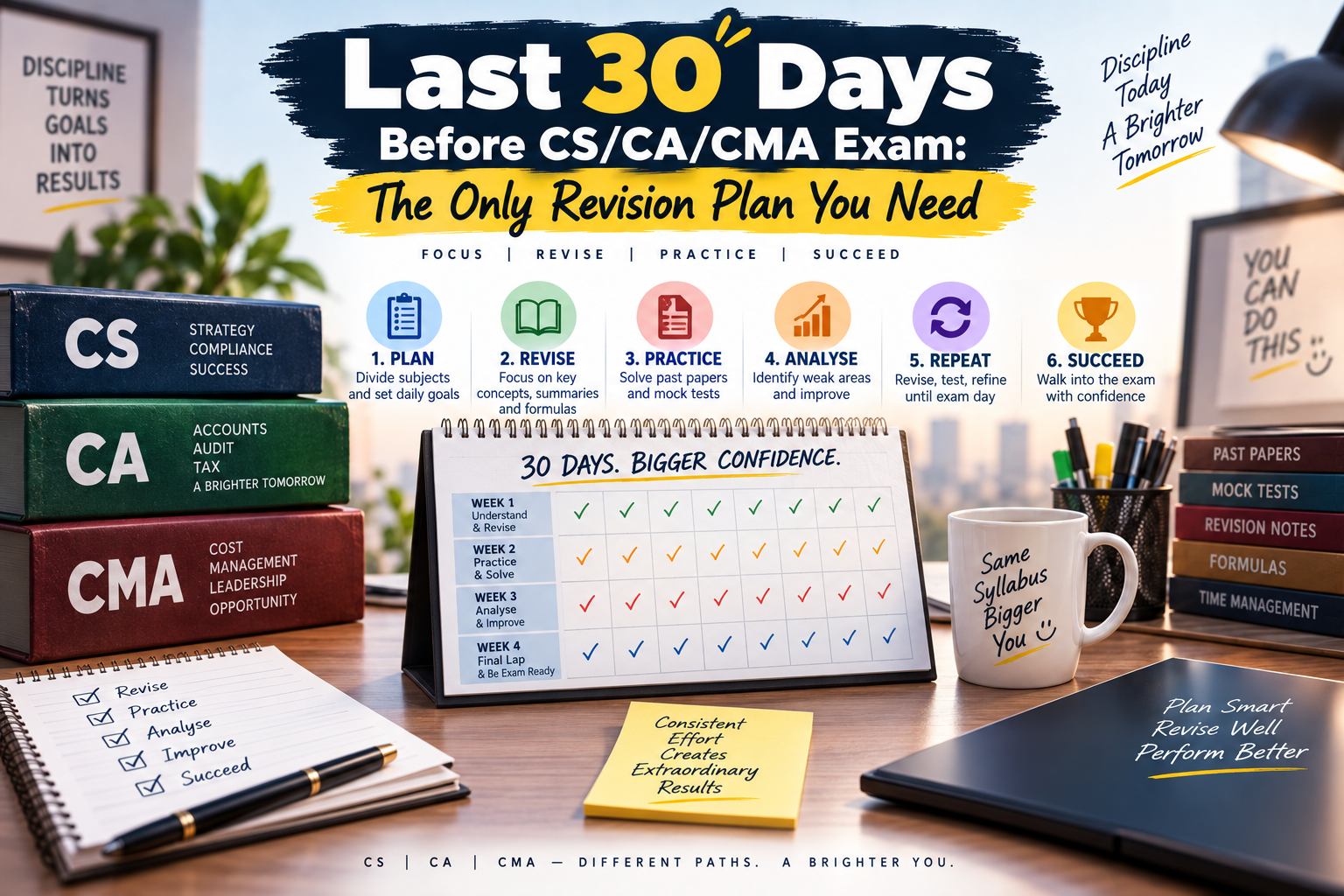
The 30-Day Countdown Plan
Days 30–21: Rapid Revision Sweep
Cover all subjects at high speed. One topic per Pomodoro. Brain dumps only — no reading from scratch. Identify what's solid vs. what needs attention. Create a "weakness list" per subject.
Cover all subjects at high speed. One topic per Pomodoro. Brain dumps only — no reading from scratch. Identify what's solid vs. what needs attention. Create a "weakness list" per subject.
Days 20–11: Weakness Attack
Focus exclusively on items from your weakness list. Active recall for every weak topic. Flashcard drilling. Work through past paper questions on these topics only.
Focus exclusively on items from your weakness list. Active recall for every weak topic. Flashcard drilling. Work through past paper questions on these topics only.
Days 10–4: Mock Exam Blitz
One full mock per day (rotate subjects). Exam conditions — timed, closed book. Review next morning. Focus on answer structure and time management, not new content.
One full mock per day (rotate subjects). Exam conditions — timed, closed book. Review next morning. Focus on answer structure and time management, not new content.
Days 3–1: Light Touch Revision
Only key summaries, formulas, and mnemonics. No heavy new material. Early sleep (by 10pm). Mental preparation. Light walks. Trust your preparation.
Only key summaries, formulas, and mnemonics. No heavy new material. Early sleep (by 10pm). Mental preparation. Light walks. Trust your preparation.
💡 Day-by-Day Subject Rotation (CA Final Example)
Week 1: SFM + Advanced Accounts (high marks weight)
Week 2: Tax + Audit (theory-heavy — needs fresh recall)
Week 3: Costing + Law + ISCA (mop up remaining gaps)
Week 4: Mock exams rotating all papers + final formula revision
Week 1: SFM + Advanced Accounts (high marks weight)
Week 2: Tax + Audit (theory-heavy — needs fresh recall)
Week 3: Costing + Law + ISCA (mop up remaining gaps)
Week 4: Mock exams rotating all papers + final formula revision
⚠️ 30-Day Danger Zones
❌ Starting new chapters not in your original plan
❌ Skipping mock tests "because I need more revision time"
❌ Studying past midnight (sleep is non-negotiable for memory)
❌ Abandoning exercise and meals (cognitive fuel matters)
❌ Comparing revision progress with classmates (irrelevant)
❌ Starting new chapters not in your original plan
❌ Skipping mock tests "because I need more revision time"
❌ Studying past midnight (sleep is non-negotiable for memory)
❌ Abandoning exercise and meals (cognitive fuel matters)
❌ Comparing revision progress with classmates (irrelevant)
❌ Panic-Driven Last Month
- Random topic selection by anxiety
- Re-reading everything from scratch
- No mock tests ("not ready yet")
- Sleep 4–5 hours to "study more"
- End result: exhausted, underconfident
✅ Strategic Last Month
- Systematic rapid revision + weakness focus
- Retrieval practice, not re-reading
- 10 mock exams across subjects
- 7–8 hours sleep every night
- End result: sharp, confident, ready
🎯 The Most Important Action Today
Make your weakness list right now. Open your notes for each subject. Scan through. On a separate page, write every topic that makes you feel uncertain. That list is your entire priority for the next 30 days.
Make your weakness list right now. Open your notes for each subject. Scan through. On a separate page, write every topic that makes you feel uncertain. That list is your entire priority for the next 30 days.
- Weakness list created for each subject
- 30-day countdown plan written with specific daily targets
- Mock exams scheduled (10 minimum across all papers)
- Sleep minimum 7 hours locked into schedule
- No new chapters after Day 21
- Formula and law section summary sheets prepared
- Study stop time: 10pm latest
🔑 Key Takeaway
The last 30 days don't build your foundation — they sharpen what's already there. Consolidate, don't cram. Test, don't read. Sleep, don't deprive. The students who peak on exam day are the ones who planned these 30 days with precision.
The last 30 days don't build your foundation — they sharpen what's already there. Consolidate, don't cram. Test, don't read. Sleep, don't deprive. The students who peak on exam day are the ones who planned these 30 days with precision.
Mock Test Score Progression: What Growth Actually Looks Like
Mock Test Score Trajectory Over 90 Days (Typical Topper Journey)
% score | Typical topper trajectory — steady improvement is the goal, not overnight perfection
Mock 1 at 34% is expected and normal. Students who panic at this score and abandon the strategy fail. Students who treat Mock 1 as diagnostic data and fix exactly what it reveals score 69%+ by Mock 6. The trajectory is the story, not the absolute score.
Mock Test Analysis Framework
| Question Type Missed | Root Cause | Fix Strategy | Time Required |
|---|---|---|---|
| Definition/provision questions | Didn't learn exact text | Flashcards + active recall | 30 min/topic |
| Computation errors | Formula gap or calculation error | 5 practice problems on that formula | 1 hr/formula |
| Application/scenario questions | Concept known, application weak | 3 more scenario questions same topic | 45 min/topic |
| Time management failure | No time strategy in exam | Practice timed section blocks | 2 timed mocks |
| Silly mistakes | Rushing, anxiety, poor re-check habit | Build 10-min re-check into all mocks | Habit change |
The 24-Hour Post-Mock Protocol
What to do in the 24 hours after every mock test:
Hour 0 (immediately after): Write down on a blank page the 5 questions that hurt most. Don't check answers yet. Sit with the discomfort of uncertainty.
Hour 1–3 (same day): Check answers. For every wrong answer: (a) note the topic, (b) rate your error — "didn't know" vs "knew but made a mistake" vs "knew but misunderstood the question". Each has a different fix.
Day 2 (next day): For "didn't know" errors: read that topic section thoroughly. For "made a mistake" errors: identify the specific error and drill the correct method 3 times. For "misunderstood question" errors: practice reading exam questions more carefully.
Day 3 (two days later): Re-answer all your wrong questions from memory. Aim for 100% correct. If not, repeat step 2.
Hour 0 (immediately after): Write down on a blank page the 5 questions that hurt most. Don't check answers yet. Sit with the discomfort of uncertainty.
Hour 1–3 (same day): Check answers. For every wrong answer: (a) note the topic, (b) rate your error — "didn't know" vs "knew but made a mistake" vs "knew but misunderstood the question". Each has a different fix.
Day 2 (next day): For "didn't know" errors: read that topic section thoroughly. For "made a mistake" errors: identify the specific error and drill the correct method 3 times. For "misunderstood question" errors: practice reading exam questions more carefully.
Day 3 (two days later): Re-answer all your wrong questions from memory. Aim for 100% correct. If not, repeat step 2.
🎓 E-mentor's Mock Test Ecosystem
E-mentor's test series includes chapter tests, subject tests, and full mock papers — all structured to simulate the actual CA/CMA/CS exam environment. Use chapter tests for daily practice, subject tests after completing each subject (monthly), and full mocks in Months 4–6. E-mentor's instant scoring and answer explanations make the 24-hour post-mock protocol highly efficient — you don't need to manually look up every answer, saving 2+ hours per mock analysis session. Schedule your E-mentor mock tests and treat them as fixed exam dates.
E-mentor's test series includes chapter tests, subject tests, and full mock papers — all structured to simulate the actual CA/CMA/CS exam environment. Use chapter tests for daily practice, subject tests after completing each subject (monthly), and full mocks in Months 4–6. E-mentor's instant scoring and answer explanations make the 24-hour post-mock protocol highly efficient — you don't need to manually look up every answer, saving 2+ hours per mock analysis session. Schedule your E-mentor mock tests and treat them as fixed exam dates.
📎 Official Resources
