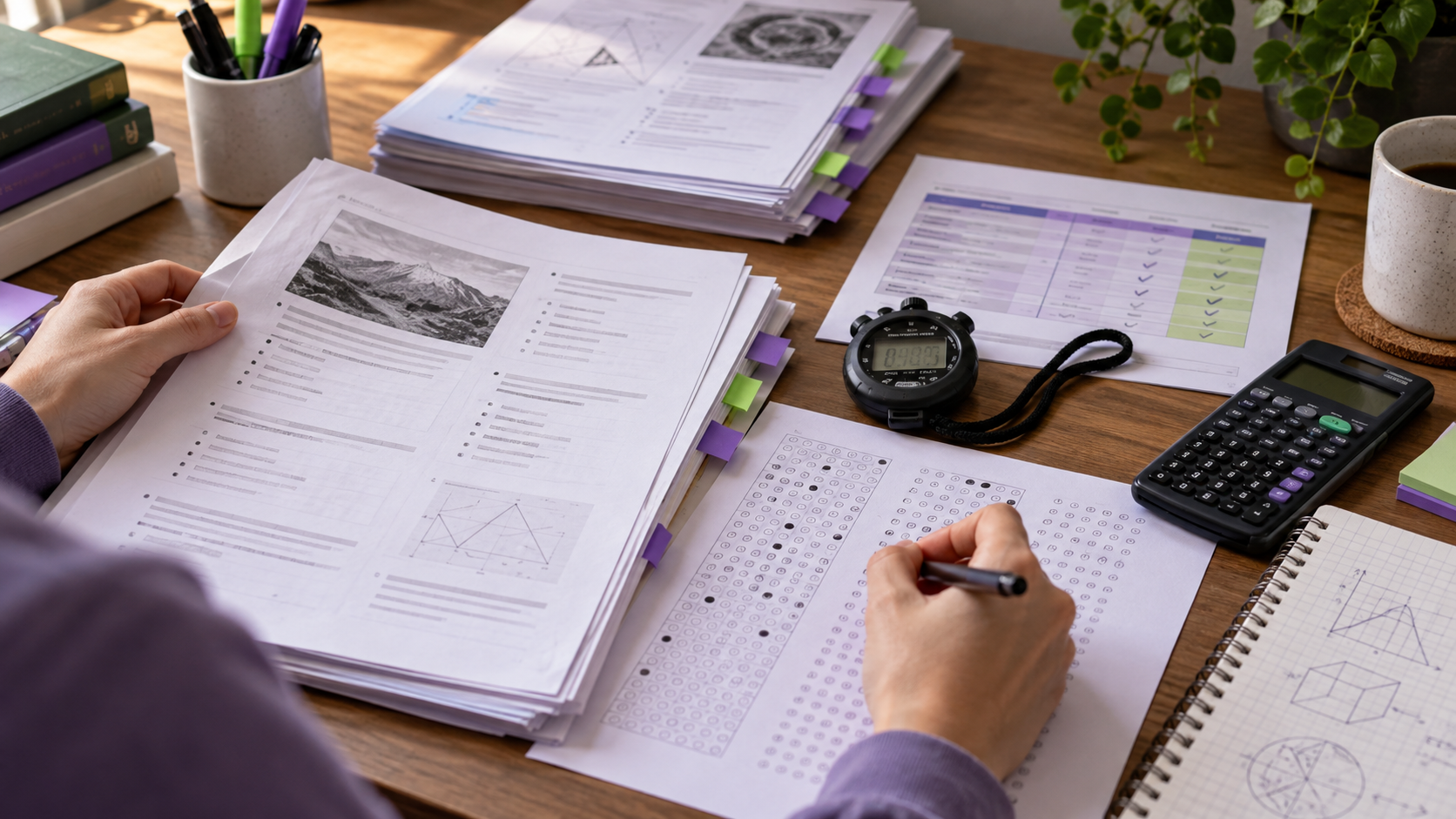
Past papers sit in most students' folders — used for "reference" at the end of preparation. This is backwards. Past papers are not the final test of preparation. They are the engine of preparation. Used correctly, they should drive everything you do.
What Past Papers Actually Tell You
A past paper is not just a practice test. It is an official communication from the examining body about what they value, how they ask questions, what level of depth they expect, and which topics appear repeatedly. This intelligence is available for free — but only students who systematically analyze papers extract it.
Anders Ericsson's deliberate practice research identifies task-specificity as critical: practice that mirrors the actual performance environment produces superior skill transfer. Past papers mirror the exact environment of the exam — question format, language style, time pressure, marking scheme. No other study method achieves this alignment.
The 5-Step Past Paper System
Phase 1: Intelligence Gathering (Before You Start)
Collect last 5 years of past papers for your subject. Create a table: columns = question numbers, rows = paper years. For each question, note the topic. After completing the table, identify:
- Topics appearing in 4–5 of 5 papers = Core topics (guaranteed syllabus)
- Topics appearing in 2–3 papers = High-probability topics
- Topics appearing once = Lower priority
Allocate study time proportionally. Core topics deserve 2× the time of low-frequency topics.
Phase 2: Attempt Strategy
Your first attempt on any paper: attempt under time pressure but with notes available. Purpose: understand question formats, see what a complete answer looks like. This is learning, not testing.
3–4 weeks later: same paper, fully closed book, strict exam conditions. Now it's a genuine assessment. Compare with first attempt and model answers. The gap between attempts shows your retention over 3–4 weeks.
After each attempt: study model answers carefully. Note: structure used, specific language, depth of analysis, conclusions. ICAI/ICSI model answers are the benchmark — every point they award is a point structure worth practicing.
Common Past Paper Mistakes
❌ Reading past papers without attempting them
❌ Attempting open-book as the only practice (too easy, doesn't simulate exam)
❌ Not reviewing model answers carefully after each attempt
❌ Only doing 1–2 papers per subject
❌ Using old papers only (last 3 years are highest priority)
❌ Attempting all questions when exam allows choice (practice selection strategy too)
- "I'll read past papers for reference"
- Skim papers, don't attempt
- Check answers without noting gaps
- 1 paper per subject
- Frequency analysis drives study priorities
- Multiple timed attempts per paper
- Model answer comparison + gap targeting
- 5+ papers per subject
Pick your hardest subject. Download last 5 years of past papers. Create a topic frequency table. Identify the top 5 most-tested topics. These 5 topics now become your priority until they're mastered. This 30-minute exercise could be the most valuable preparation investment you make.
- 5-year past paper frequency analysis done for each subject
- Study priorities realigned based on frequency data
- First attempt (open book) completed per paper
- Second attempt (closed book, timed) completed 3–4 weeks later
- Model answer comparison done after every attempt
- Gap list maintained and actioned after each attempt
- Minimum 5 past papers completed per subject
Past papers are not the end of preparation — they are the compass that guides preparation. Frequency analysis tells you what to study. Timed attempts build exam skills. Model answer comparison sharpens answer quality. Use all three dimensions. Students who systematically use 5+ past papers per subject consistently outperform those who use 1–2.
Exercise and Academic Performance: What the Data Shows
Exam Score Improvement After 8-Week Exercise Program vs. Control
% improvement in retention tests after 8 weeks | Ratey & Loehr (2011) adapted
Moderate exercise (45 minutes, 5 days a week) produces the highest cognitive benefit — a 18% improvement in academic performance tests. High exercise (60+ minutes daily) actually slightly underperforms moderate, as the physical recovery demand starts competing with cognitive resources.
Exercise + Study: Optimal Integration Schedule
| Exercise Type | Duration | Best Time | Cognitive Benefit |
|---|---|---|---|
| Brisk walk | 20–30 min | Morning (before study) or lunch | BDNF release, cortisol regulation |
| Yoga / stretching | 20–30 min | Early morning | Stress reduction, improved focus |
| Cycling / running | 30–45 min | Afternoon (post-lunch block) | Hippocampal neurogenesis — memory formation |
| Sports (cricket, badminton) | 30–60 min | Evening (after study) | Full recovery, dopamine reset |
Brain-Derived Neurotrophic Factor (BDNF) is a protein that supports neuron growth and synapse formation — literally the physical infrastructure of memory and learning. Exercise, particularly aerobic exercise, is the most potent trigger for BDNF release that researchers have found.
John Ratey's work at Harvard showed that students who exercised before learning new material retained it at significantly higher rates than students who did not. For CA Final students studying complex Ind AS or intricate legal provisions: a 20-minute walk before your hardest study block is not a luxury. It's a cognitive preparation tool backed by neuroscience.
Schedule your E-mentor practice sessions 30–60 minutes after your physical activity window. The post-exercise BDNF peak aligns with peak memory encoding — making your E-mentor practice more effective. Students who exercise in the afternoon and take E-mentor tests in the evening often notice improved recall accuracy compared to testing immediately after sedentary study. The sequence matters: move the body, then challenge the mind.
📎 Official Resources
