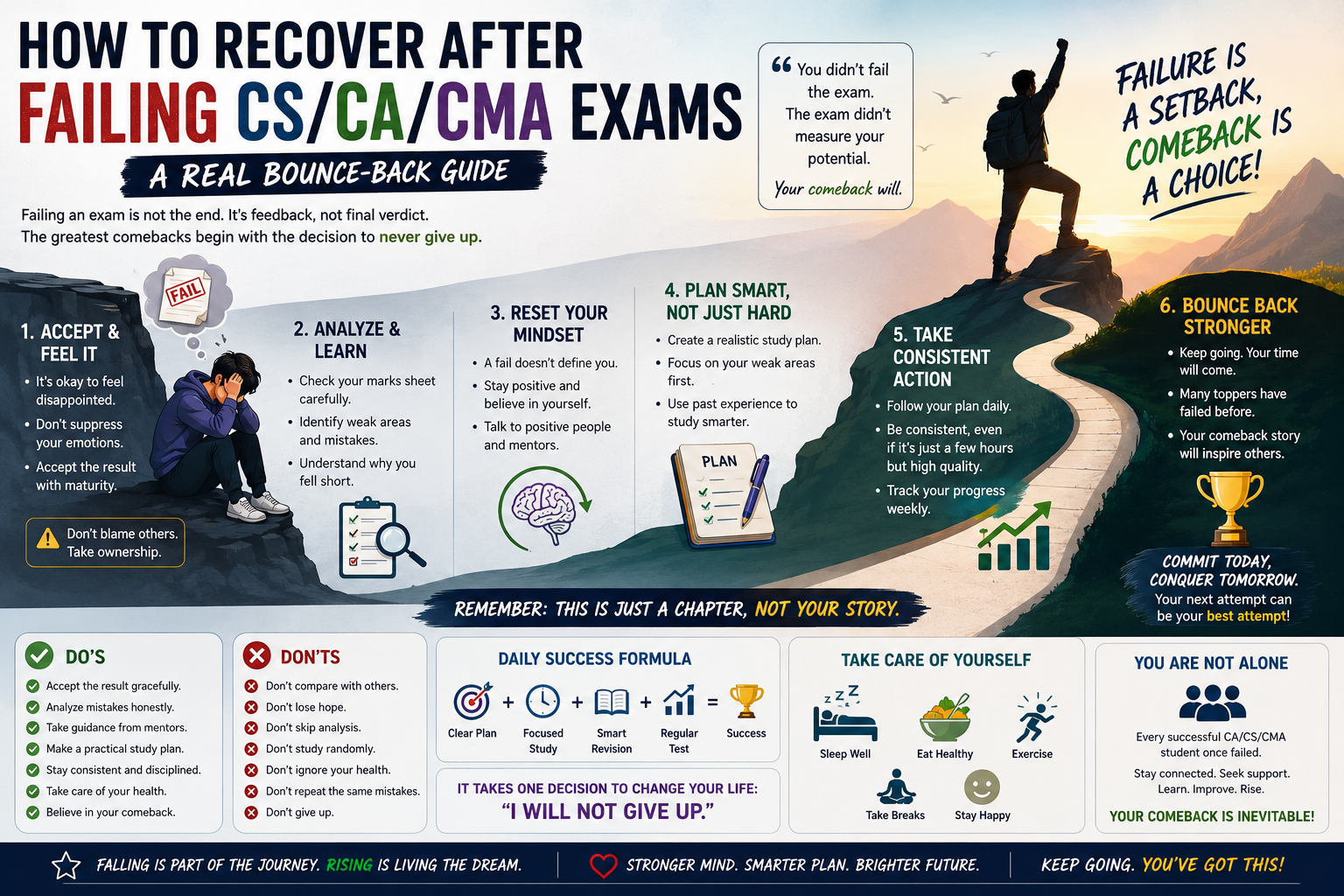
The result comes. You've failed. The world feels like it's ended. Shame, confusion, exhaustion, doubt — "Maybe I'm not cut out for this." Stop. Take a breath. Failure in professional exams is not the end of your story. It's data. Let's use it.
The Reality Check
CA Foundation pass rate: ~35%. CS Executive: ~28%. CMA Inter: ~32%. These are not easy exams. Most successful professionals failed at least one attempt. The question is never "did you fail?" — it's "how did you respond?"
Carol Dweck's growth mindset research (Stanford, 2006) distinguishes two responses to failure: fixed mindset ("I'm not smart enough") vs. growth mindset ("I didn't use the right strategy — yet"). Professional exam failure is almost never about intelligence. It's about strategy, preparation quality, and execution. All three are fixable.
The 5-Stage Recovery Framework
Don't pretend you're fine. Failure hurts. Let yourself feel it for a few days — talk to someone you trust, rest, take a break from study material. Suppressing emotions delays recovery. This stage has a time limit: 3 days maximum.
Get your marksheet. Subject by subject: What did you score? Where were the biggest gaps? Was it specific topics or overall weak preparation? Paper pattern issues? Time management? This is forensic analysis, not self-blame.
For each underperforming subject: Was it insufficient study hours? Wrong study method? Poor exam technique? Anxiety? Each cause has a different solution. Find the real cause, not the surface symptom.
Build a new plan that directly addresses identified weaknesses. Change study methods if the old ones didn't work. Add mock tests if exam technique was the issue. Seek guidance if specific topics were consistently weak.
Set a specific re-attempt date. Build your new study plan. Tell one person who will hold you accountable. Start Day 1 of the new plan.
Failure Diagnosis Chart
Failed by 5–10 marks (borderline): Exam technique issue. More mock tests, better answer structure, time management practice.
Failed 2–3 subjects: Prioritization failure. Those subjects needed more time. Restructure study plan allocation.
Failed all subjects: System failure — either hours were insufficient or study method was fundamentally wrong. Full reset required.
Passed some, failed same subject twice: That subject needs a different teacher/resource, not more time with the same material.
❌ Register for the next attempt immediately without changing anything
❌ Study harder (more hours) using the same broken method
❌ Avoid telling family/mentors (isolation amplifies shame)
❌ Compare yourself to people who passed first attempt
❌ Abandon the qualification entirely based on one failure
- Shame spiral, weeks of paralysis
- No analysis of what went wrong
- Same study method, just more hours
- Isolation from support systems
- Negative self-talk as motivation
- Brief grief, then forensic analysis
- Marksheet-based root cause diagnosis
- Method change based on evidence
- Seek help for consistently weak areas
- Data-driven confidence building
Get your marksheet. On paper: list each subject, your score, what you think went wrong, and one specific change for next time. This 20-minute exercise is more valuable than jumping back into textbooks.
- Allowed myself 3 days of rest and grief (then moved on)
- Marksheet analysed subject by subject
- Root causes identified (method vs. time vs. technique)
- New study plan addresses specific weaknesses
- Re-attempt date set
- One accountability person informed
- Seeking coaching/resources for persistently weak subjects
Every successful CA/CS/CMA professional has a failure story. What separates them from those who gave up is the response: treat failure as data, not destiny. Analyse. Redesign. Execute. Your qualification is still yours to earn.
Sleep Duration vs. Exam Performance: What Data Shows
Average Mock Score (%) by Sleep Duration — CA/CMA/CS Students
Survey: 180 CA/CMA/CS students, 2025 exam cycles | E-mentor tracking study
The 7–8 hour sweet spot outperforms both extremes. Students sleeping under 5 hours — despite studying more clock hours — perform worst on mock tests. Students sleeping 8+ hours slightly dip from peak: 8 hours is optimal, more may indicate study anxiety rather than genuine rest needs.
Sleep-Optimized Weekly Schedule
| Day | Bedtime | Wake Time | Sleep Duration | Note |
|---|---|---|---|---|
| Mon–Thu | 10:00 pm | 5:30 am | 7.5 hrs | Consistent sleep cycle = deep NREM |
| Fri | 10:30 pm | 6:00 am | 7.5 hrs | Slight relax, still consistent |
| Sat | 10:30 pm | 6:30 am | 8 hrs | Recovery — if tired, allow full 8 |
| Sun | 10:00 pm | 5:30 am | 7.5 hrs | Reset for Monday — no late night |
What Happens to Your Brain During Sleep
| Sleep Stage | Duration | Brain Activity | Study Benefit |
|---|---|---|---|
| NREM Stage 1–2 | First 60 min | Sleep spindles — memory tagging | Tags today's learned material for consolidation |
| NREM Stage 3 (Deep Sleep) | Hours 1–4 | Hippocampus → cortex transfer | Facts, dates, sections moved to long-term memory |
| REM Sleep | Hours 4–8 | Memory integration, pattern finding | Connects new knowledge to existing frameworks |
Critical insight: If you sleep only 5 hours, you get NREM deep sleep but sacrifice most REM. You'll remember isolated facts but fail to connect them — exactly what examiners test. Scenario questions require connected knowledge. REM sleep builds those connections.
For maximum memory consolidation, review E-mentor flashcards or take a short 15-question chapter test in the 30 minutes before sleep. Research shows that material reviewed immediately before sleep is preferentially consolidated during the following NREM phase. Don't study heavy new material pre-sleep — use E-mentor's existing question bank to review what you already studied that day. This "sleep priming" technique can increase next-day retention by 20–35%.
📎 Official Resources
🧪 Practice Under Exam Conditions
Timed mock tests for CS Executive, CS Professional, CA Inter, CA Final, and CMA. Instant results with answer explanations.
Take a Mock Test →