The Problem
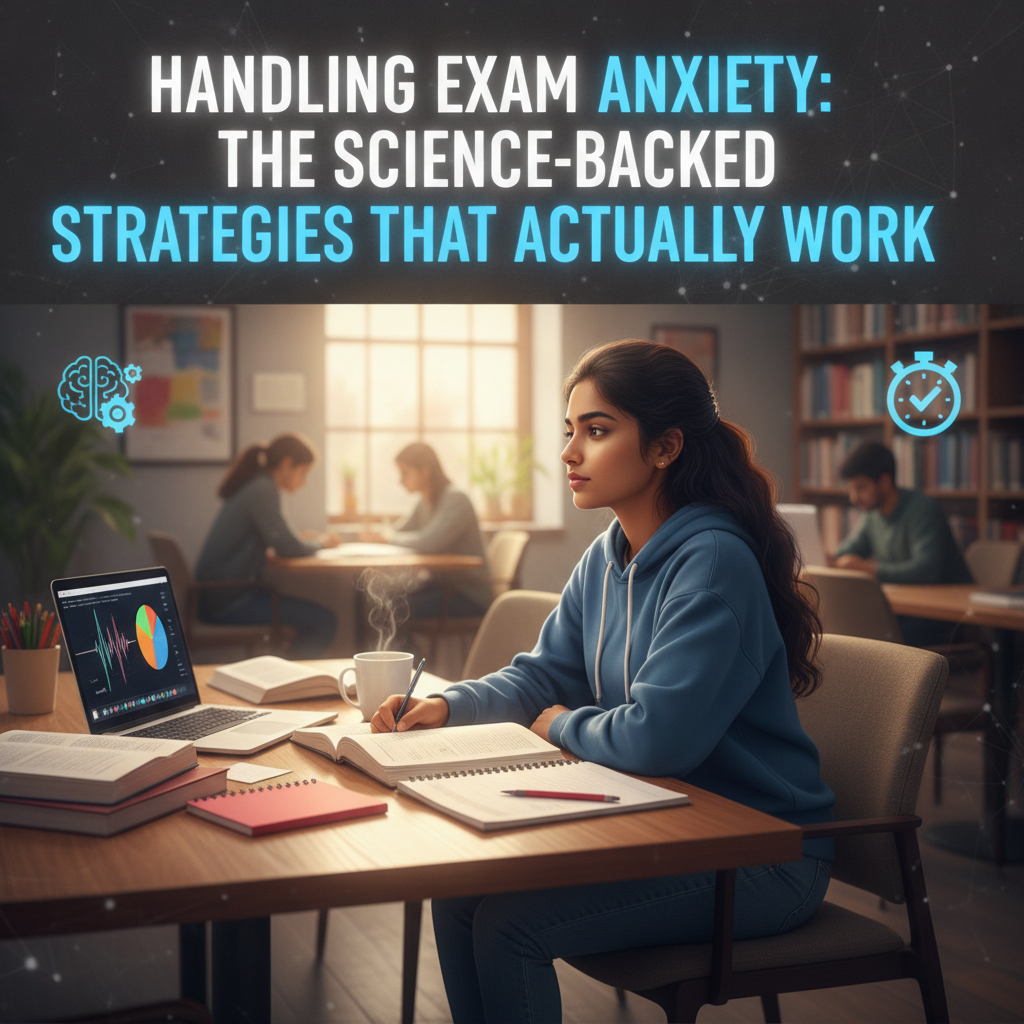
You know the content. You've prepared well. But the moment the exam starts, your heart races, your hands sweat, the question paper blurs, and everything you studied seems to vanish. Exam anxiety is not weakness — it's a neurological event. And it has a science-based solution.
You know the content. You've prepared well. But the moment the exam starts, your heart races, your hands sweat, the question paper blurs, and everything you studied seems to vanish. Exam anxiety is not weakness — it's a neurological event. And it has a science-based solution.
What Exam Anxiety Actually Does to Your Brain
When the amygdala (threat detection center) fires, cortisol and adrenaline flood the prefrontal cortex — reducing access to complex reasoning, memory retrieval, and organized thinking. This is the biological basis of "going blank." The content is in long-term memory, but the anxiety response impairs the retrieval mechanism.
🔬 Yerkes-Dodson Law
Moderate arousal (alertness + mild tension) actually enhances performance. The problem is when arousal exceeds optimal levels — it impairs performance. Exam anxiety management is not about eliminating nervousness entirely (some is beneficial) but about keeping arousal within the optimal performance zone. Specific techniques below achieve precisely this.
Moderate arousal (alertness + mild tension) actually enhances performance. The problem is when arousal exceeds optimal levels — it impairs performance. Exam anxiety management is not about eliminating nervousness entirely (some is beneficial) but about keeping arousal within the optimal performance zone. Specific techniques below achieve precisely this.
Pre-Exam Anxiety Management
Technique 1: Preparation as Anxiety Medication
The single most effective anxiety reducer is systematic preparation. Students who have taken 10+ mock tests under exam conditions do not experience the same anxiety as those who haven't — the exam environment is familiar, not threatening. Preparation is the foundation of confidence.
The single most effective anxiety reducer is systematic preparation. Students who have taken 10+ mock tests under exam conditions do not experience the same anxiety as those who haven't — the exam environment is familiar, not threatening. Preparation is the foundation of confidence.
Technique 2: Physiological Regulation (Night Before)
The night before: eat early and light, stop all new studying by 9pm, take a 10-minute walk, warm shower, read something non-study related, lights out by 10:30pm. This sequence calms the nervous system and allows restorative sleep.
The night before: eat early and light, stop all new studying by 9pm, take a 10-minute walk, warm shower, read something non-study related, lights out by 10:30pm. This sequence calms the nervous system and allows restorative sleep.
Technique 3: Morning Routine (Exam Day)
Wake at least 2 hours before exam. Eat a proper breakfast (blood sugar stability reduces anxiety). 10 minutes of slow walking. Review only your summary notes — no new material. Arrive at the venue 15 minutes early. Early arrival eliminates the logistical anxiety layer.
Wake at least 2 hours before exam. Eat a proper breakfast (blood sugar stability reduces anxiety). 10 minutes of slow walking. Review only your summary notes — no new material. Arrive at the venue 15 minutes early. Early arrival eliminates the logistical anxiety layer.
In-Exam Anxiety Techniques
Technique 4: Box Breathing
When anxiety spikes: inhale for 4 counts, hold for 4, exhale for 4, hold for 4. Repeat 4 times. This activates the parasympathetic nervous system ("rest and digest"), directly counteracting the sympathetic anxiety response. Takes 64 seconds. Measurably reduces cortisol.
When anxiety spikes: inhale for 4 counts, hold for 4, exhale for 4, hold for 4. Repeat 4 times. This activates the parasympathetic nervous system ("rest and digest"), directly counteracting the sympathetic anxiety response. Takes 64 seconds. Measurably reduces cortisol.
Technique 5: Grounding (5-4-3-2-1)
When your mind races or blanks: identify 5 things you can see, 4 you can touch, 3 you can hear, 2 you can smell, 1 you can taste. This interrupts the anxiety thought loop and brings attention to the present moment, reducing amygdala activation.
When your mind races or blanks: identify 5 things you can see, 4 you can touch, 3 you can hear, 2 you can smell, 1 you can taste. This interrupts the anxiety thought loop and brings attention to the present moment, reducing amygdala activation.
Technique 6: Write First, Recall Second
If you blank on a question: write the topic heading. Write any word associated with it. Write whatever you remember, even if uncertain. Writing activates memory retrieval networks through a different pathway than pure recall — often unlocking information that seemed inaccessible.
If you blank on a question: write the topic heading. Write any word associated with it. Write whatever you remember, even if uncertain. Writing activates memory retrieval networks through a different pathway than pure recall — often unlocking information that seemed inaccessible.
Technique 7: Reframe Arousal
Harvard research (Alison Wood Brooks, 2014) found that people who told themselves "I am excited" before high-pressure tasks performed significantly better than those who said "I am calm." Arousal is the same neurologically — the interpretation matters. Tell yourself: "This is my moment. I've prepared for this."
Harvard research (Alison Wood Brooks, 2014) found that people who told themselves "I am excited" before high-pressure tasks performed significantly better than those who said "I am calm." Arousal is the same neurologically — the interpretation matters. Tell yourself: "This is my moment. I've prepared for this."
⚠️ Anxiety Amplifiers to Avoid
❌ Talking to other students before the exam about "how much they studied"
❌ Skimming notes in the exam hall (adds confusion, not confidence)
❌ Comparing your paper speed to others' writing pace
❌ Catastrophizing a blank moment ("I've failed") — this is temporary
❌ Caffeine overload on exam day (amplifies anxiety response)
❌ Talking to other students before the exam about "how much they studied"
❌ Skimming notes in the exam hall (adds confusion, not confidence)
❌ Comparing your paper speed to others' writing pace
❌ Catastrophizing a blank moment ("I've failed") — this is temporary
❌ Caffeine overload on exam day (amplifies anxiety response)
🎯 Practice Box Breathing Right Now
Try it: inhale counting 4 (1...2...3...4), hold for 4, exhale for 4, hold for 4. Repeat 4 times. Notice the physical relaxation in your shoulders and chest. This 64-second technique should be your first response whenever anxiety spikes — in a mock or in the actual exam.
Try it: inhale counting 4 (1...2...3...4), hold for 4, exhale for 4, hold for 4. Repeat 4 times. Notice the physical relaxation in your shoulders and chest. This 64-second technique should be your first response whenever anxiety spikes — in a mock or in the actual exam.
- Box breathing practiced until automatic (daily 2-minute practice)
- 10+ mock tests completed to normalize exam conditions
- Night-before routine established and followed
- Exam-day breakfast and timing planned
- Arrive 15 minutes early at venue
- No new material on exam day
- Reframe script ready: "I've prepared. I'm ready. This is my moment."
🔑 Key Takeaway
Exam anxiety is a biological response that can be managed with specific, practiced techniques. The two most powerful interventions are: (1) systematic preparation that makes exam conditions familiar rather than threatening, and (2) in-exam physiological regulation through controlled breathing. Both are trainable. Practice them before you need them.
Exam anxiety is a biological response that can be managed with specific, practiced techniques. The two most powerful interventions are: (1) systematic preparation that makes exam conditions familiar rather than threatening, and (2) in-exam physiological regulation through controlled breathing. Both are trainable. Practice them before you need them.
Study Environment: What Students Use vs. What Works
Where CA/CMA/CS Students Study (n=240)
Primary study location | E-mentor student survey 2025
Optimal Study Environment Design
| Environmental Factor | Optimal Setting | Common Mistake | Impact on Focus |
|---|---|---|---|
| Lighting | Natural light or bright white LED, 6500K | Warm yellow lighting (induces drowsiness) | Alertness +23% |
| Temperature | 21–23°C (slightly cool) | Hot, stuffy room = drowsiness | Accuracy +12% in cool rooms |
| Sound | Silence or 60–70 dB white/brown noise | Studying with TV/music with lyrics | Reduces working memory load |
| Desk organization | Only current subject materials visible | Cluttered desk = visual distraction | Task initiation improved |
| Phone position | Different room, face down, DND | "In sight but on silent" — still disrupts | Even sight of phone reduces cognitive capacity |
The "Mere Presence" Effect (Ward et al., 2017)
Research at University of Texas found that the mere presence of a smartphone on your desk — even face-down and silent — reduces available cognitive capacity because part of your brain is continuously managing the impulse to check it. The effect is larger for people with high smartphone dependence.
For CA/CMA/CS students whose subjects require full working memory capacity (SFM calculations, complex journal entries, multi-step legal analysis): phone presence during study blocks measurably impairs performance. The fix is simple and free: put the phone in another room. Not on the desk. Not in your bag. Another room.
Research at University of Texas found that the mere presence of a smartphone on your desk — even face-down and silent — reduces available cognitive capacity because part of your brain is continuously managing the impulse to check it. The effect is larger for people with high smartphone dependence.
For CA/CMA/CS students whose subjects require full working memory capacity (SFM calculations, complex journal entries, multi-step legal analysis): phone presence during study blocks measurably impairs performance. The fix is simple and free: put the phone in another room. Not on the desk. Not in your bag. Another room.
🎓 Design Your E-mentor Environment
When taking E-mentor tests, replicate exam conditions: desk cleared, phone in another room, door closed, timer running. Students who take E-mentor tests casually (scrolling between questions, checking WhatsApp between tests) are training themselves to perform casually. Students who treat every E-mentor test as a real exam train exam-level performance. The physical environment is the trigger — same space, same setup, same focus = same performance. Your study environment is conditioning, not just comfort.
When taking E-mentor tests, replicate exam conditions: desk cleared, phone in another room, door closed, timer running. Students who take E-mentor tests casually (scrolling between questions, checking WhatsApp between tests) are training themselves to perform casually. Students who treat every E-mentor test as a real exam train exam-level performance. The physical environment is the trigger — same space, same setup, same focus = same performance. Your study environment is conditioning, not just comfort.
📎 Official Resources
🧪 Practice Under Exam Conditions
Timed mock tests for CS Executive, CS Professional, CA Inter, CA Final, and CMA. Instant results with answer explanations.
Take a Mock Test →