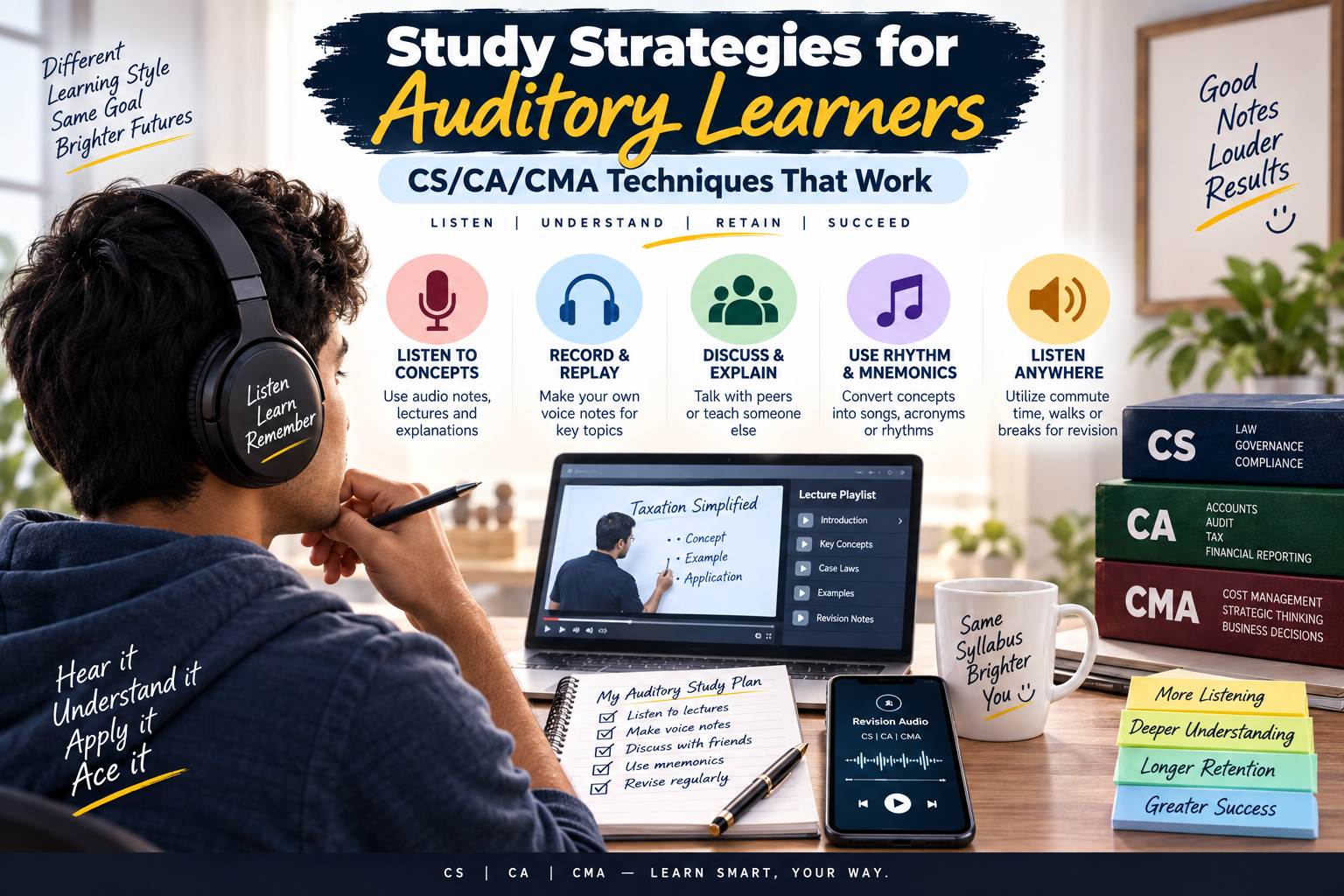
Reading doesn't work for you the way it seems to work for others. You understand lectures better than textbooks. You remember conversations better than notes. You're not lazy or less intelligent — you're an auditory learner in a system designed for visual learners.
What is Auditory Learning?
Auditory learners process and retain information better through listening and speaking than through reading. This is a genuine cognitive preference — approximately 30% of people learn most effectively through auditory channels. The problem is that most exam preparation systems are built around reading and writing.
The VARK model (Neil Fleming, 1987) identifies four learning modalities: Visual, Auditory, Read/Write, and Kinesthetic. Research suggests that while pure modality preferences vary between individuals, tailoring study methods to dominant preferences improves engagement and retention — particularly when the learner strongly prefers one modality.
Top Auditory Study Strategies
After reading a topic, close the book and explain it out loud to an imaginary student. Speaking forces active processing. Record yourself if possible — playback reveals gaps you missed.
Read your summary notes into a voice recorder (phone is fine). Play back during commutes, meals, exercise. Passive audio reinforcement during non-study time adds significant review hours.
Instead of silent reading, read key passages aloud. The act of vocalizing engages your auditory memory channel and improves retention significantly for auditory learners.
Explaining concepts to others and hearing explanations are powerful auditory learning tools. Schedule regular study group sessions focused on verbal discussion — not silent co-reading.
For theoretical subjects (Law, Auditing, Economics), find quality audio resources — ICAI videos, CA mentor lectures, YouTube explanations. Supplement reading with audio consistently.
Convert key lists into rhythmic phrases or simple songs. "SEBI stands for Securities and Exchange Board of India" → set to a 4-beat rhythm you can tap while recalling. Auditory learners retain rhythmic information exceptionally well.
Auditory-Adapted Study Schedule
Morning (silent time): Active recall brain dumps — write what you remember from yesterday
Main study block: Read aloud + recorded notes for new material
Break: Listen to recorded notes from last week (passive review)
Afternoon: Teach-back session — explain 3 topics aloud with recording
Evening: Study group or discussion (2–3 times weekly)
Before sleep: 10-min audio review of day's key points
- Re-reading same pages repeatedly
- Highlighted textbooks with low retention
- Silent study that feels unproductive
- Self-blame for "poor memory"
- Lecture + audio + teach-back combinations
- Recorded summaries for passive review
- Discussion-based study groups
- Significantly improved retention and confidence
Open your phone voice recorder. Explain one topic you studied this week — out loud, from memory, for 3 minutes. Play it back. Note where you stumbled — those are your gaps. Record a clean version after reviewing. Use it for tomorrow's commute.
- Phone recorder used daily for topic explanations
- Key notes converted to audio files
- Read aloud practice during study sessions
- Study group scheduled 2–3 times per week
- Audio lectures/videos integrated into study plan
- Rhythmic mnemonics created for key lists
If reading doesn't work for you, the answer isn't to read harder — it's to study differently. Auditory learners who build audio-rich study systems consistently outperform their "visual" study attempts. Match your method to your brain. Results follow.
Stress Levels vs. Exam Performance: The Yerkes-Dodson Curve
Performance vs. Arousal Level (Yerkes-Dodson Law)
Performance index (0–100) | Yerkes & Dodson (1908) — replicated in academic performance studies
The inverted U tells the whole story: too little stress (no urgency) and too much stress (paralysis) both kill performance. Optimal arousal — the feeling of meaningful challenge without overwhelm — produces peak performance. The goal is not to eliminate exam stress but to stay in the optimal band.
Weekly Stress Self-Audit
| Symptom | Mild (1–3) | Moderate (4–6) | Severe (7–10) | Recommended Action |
|---|---|---|---|---|
| Trouble sleeping | Occasional | 3x/week | Every night | Exercise + screen-free hour pre-bed |
| Can't concentrate | After 2+ hours | Within 1 hour | Immediate | 5-4-3-2-1 grounding technique |
| Physical tension | Mild neck/back | Headaches | Daily pain | Stretching + walk 20 min daily |
| Exam panic thoughts | Rare | Weekly | Daily spirals | Write 3 things you DO know today |
Real Technique: 5-4-3-2-1 Grounding for Exam Anxiety
When panic or overwhelm hits — before a mock, during a study block, or on exam morning — stop and do this:
5: Name 5 things you can see (table, pen, book, window, light)
4: Name 4 things you can physically feel (chair, floor, air on skin, fabric)
3: Name 3 things you can hear (fan, birds, traffic)
2: Name 2 things you can smell (or favourite smells you can imagine)
1: Name 1 thing you can taste (or focus on breath)
This technique works by shifting neural attention from the threat-processing amygdala to the sensory cortex, breaking the anxiety feedback loop. It is used by Olympic athletes, military pilots, and surgeons before high-stakes performance.
A significant source of CA/CMA/CS exam anxiety is uncertainty: "Have I covered everything? Am I prepared enough?" E-mentor's systematic chapter-by-chapter test series replaces uncertainty with data. After completing E-mentor chapter tests for every topic, you have a concrete completion record. Reviewing your chapter scores gives you evidence-based confidence rather than gut-feel guessing. Students who complete E-mentor's full subject tests before their exam report significantly lower pre-exam anxiety because they know specifically what they know and what they've already addressed.
📎 Official Resources
