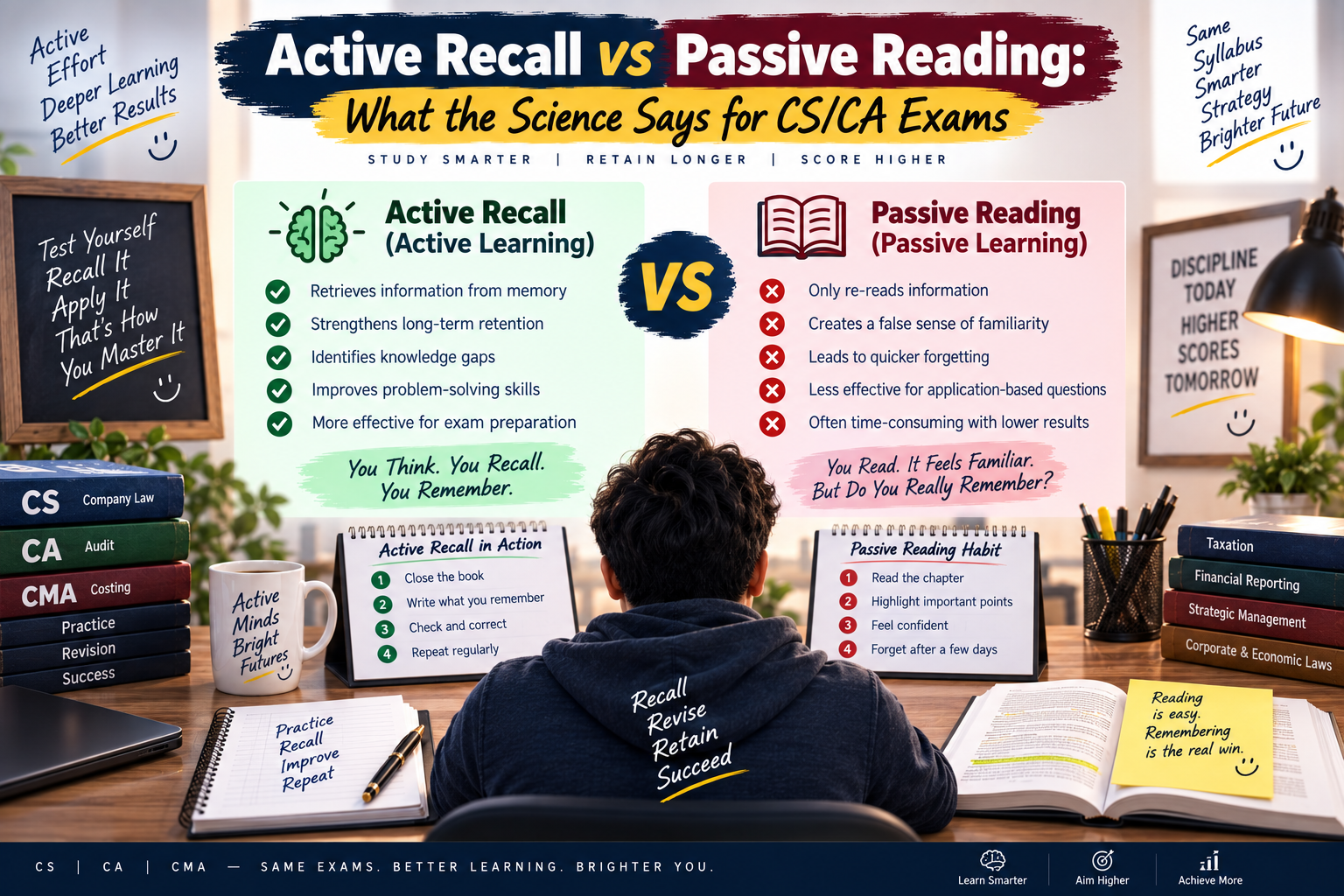
You've read the same chapter three times. You highlighted in four colors. You feel like you "know it." Then the exam question appears — and your mind goes blank. What went wrong?
The Illusion of Knowing
Passive reading creates a dangerous illusion called fluency illusion — because the text is right in front of you, your brain confuses recognition with recall. But exams test recall, not recognition. There's no textbook in the exam hall.
Henry Roediger III's landmark 2006 study showed students who used retrieval practice (active recall) scored 50% higher on final tests than those who re-read material. The act of retrieving information from memory actually strengthens the neural pathway — making future retrieval faster and more reliable.
Active Recall vs Passive Reading — The Core Difference
- Eyes move over text
- Highlighting and underlining
- Re-reading same content
- Watching lectures repeatedly
- Brain is a passenger
- Creates recognition, not recall
- Close book, write what you remember
- Answer questions from memory
- Teach concept aloud to no one
- Flashcards — question side first
- Brain is a driver
- Builds genuine recall pathways
Active Recall Methods for CA/CMA/CS
5 Active Recall Techniques
After reading a chapter, close it and write everything you can recall on a blank sheet. Compare gaps with source. This single technique can double retention.
Write question on front (e.g., "What is Section 182 of Companies Act?"), answer on back. Test yourself — always see question first.
Explain the concept aloud as if teaching a 12-year-old. When you stumble, that's the gap. Fill it, then explain again.
Attempt exam questions from memory before checking answers. This is active recall in exam format — the best exam prep possible.
After each topic, write one sentence summarizing the core idea from memory. If you can't, you don't know it well enough yet.
CA/CMA/CS-Specific Applications
Company Law (CS Executive): After reading Section 166 (Director Duties), close book, list all 8 duties from memory. Check. Repeat until complete.
CA Final — Accounts: Read consolidated accounts chapter → close → reconstruct the journal entries from scratch on blank paper.
CMA — Operations Management: After lean manufacturing — close book — draw the value stream map from memory. Label each step.
Taxation (CA/CMA): Write tax computation format from memory — not from reference. Do this for each head of income separately.
Worked Example: Company Law Revision
Old Method (Passive): Re-read Chapter 7 (Directors) 4 times over 3 days. Exam: couldn't recall section numbers or specific duties.
New Method (Active Recall):
Day 1: Read Chapter 7 once, carefully. Brain dump — filled 2 pages.
Day 1 Evening: Flashcards for 15 key sections. Self-tested — got 8/15.
Day 2: Re-read only the 7 missed. Self-tested again — 13/15.
Day 3: Full brain dump + Feynman explanation aloud.
Result: Exam — recalled all sections, wrote answer confidently, scored 18/20 on that question.
Common Mistakes
❌ Peeking at notes before trying to recall — defeats the purpose
❌ Using active recall as first pass — read first, recall second
❌ Stopping after one recall attempt — repetition is key
❌ Only recalling facts — also recall processes, sequences, formats
❌ Skipping "easy" topics — overconfidence causes blank-outs
Try This Today
Take any chapter you "finished" yesterday. Close your notes. On a blank sheet, write everything you remember about it — concepts, numbers, sections, formulas. Set 10 minutes. This single exercise will reveal exactly what you actually know vs. what you thought you knew.
- Brain dump after every chapter (blank paper, pen, 10 minutes)
- Flashcards made with question-front, answer-back format
- At least 1 Feynman explanation per major topic per week
- Past paper attempts from memory (no reference during attempt)
- Gaps identified and specifically targeted — not whole chapter re-read
- Active recall session after every study block, not just before exams
Reading and highlighting feel productive. They're not — they're comfortable. Real learning happens when your brain struggles to retrieve information. Embrace the struggle. That difficulty IS the learning. Make active recall your default study mode and watch your exam performance transform.
Q: How long should a brain dump take?
A: 10–15 minutes per chapter. Enough to exhaust what you know, not so long you're staring at blank paper.
Q: Should I use active recall for calculations too?
A: Absolutely. Write formulas from memory, reconstruct calculation formats, solve problems without referring to worked examples.
Q: Is re-reading ever useful?
A: Only for targeted gap-filling after active recall reveals specific weaknesses. General re-reading is almost always wasted time.
Retention Rates by Study Method — The Research Data
The National Training Laboratories (Maine, USA) developed the Learning Pyramid, which quantifies average retention rates 24 hours after studying using different methods. Here's how CA/CMA/CS-relevant methods compare:
| Study Method | 24-Hour Retention | Effort Required | Best For |
|---|---|---|---|
| Re-reading | 10% | Low | Familiarity only |
| Highlighting | 15% | Low | Nothing (research says so) |
| Summarizing | 25% | Medium | Synthesis of concepts |
| Practice Testing (Active Recall) | 75% | High | Everything exam-tested |
| Spaced + Active Recall | 90%+ | High | Long-term mastery |
How Students Actually Spend Study Time (vs. How They Should)
Typical student breakdown — 80% passive, 20% active
Evidence-Based Ideal Split
Topper breakdown — 80% active, 20% passive
Active Recall in Action: 3 Detailed Examples
After reading the 5-step model of revenue recognition:
Passive approach: Re-read steps 1–5 from the textbook. Highlight in yellow.
Active recall approach: Close book. Write the 5 steps from memory. Got 3/5 correct. Check. Re-read steps 4 and 5 only. Write again. Now 5/5. Next day: write 5 steps again without looking. Got 5/5 in 90 seconds.
Exam result: In the paper, recalled all 5 steps + related journal entries without hesitation.
After studying the profit difference calculation formula:
Active recall: Without notes, write the reconciliation statement format from memory. Attempt 2 past paper questions on the topic without reference. Check answers against model solutions. Identified: forgot to include fixed overhead in closing stock under absorption. Targeted fix: that specific element only. Re-tested next day: correct.
The gap identified in 15 minutes of active recall would have been invisible in 2 hours of re-reading.
Secretarial Standard SS-1 (Board Meetings): After reading, brain dump produced 8 out of 14 key requirements. Missed: quorum for adjourned meeting, notice requirements for a director outside India, video conferencing requirements.
15-minute targeted review of missed items only → next brain dump: 13/14. One more targeted review → 14/14. Total time: 45 minutes. Passive re-reading of same content would take 2 hours with 30% retention.
Active Recall Tracking System
| Subject | Chapter | Brain Dump Date | Score (self-rated) | Gap Topics | Review Date |
|---|---|---|---|---|---|
| Company Law | Ch 7 — Directors | Oct 10 | 6/10 | S.164, S.167 | Oct 12 |
| Taxation | Capital Gains | Oct 11 | 7/10 | Indexation, LTCG rate | Oct 13 |
| → Copy this template. Fill after every chapter. Your gap list drives all revision. | |||||
E-mentor's chapter-wise MCQ and descriptive question bank is built for active recall. After studying any chapter, go directly to E-mentor's test for that chapter — attempt the questions from memory. The instant feedback shows exactly which points you missed. This is structured active recall without needing to create your own questions. Use it after every chapter: Study → E-mentor Test → Brain Dump → Review Gaps. This cycle takes 90 minutes per chapter and produces 75%+ retention.
