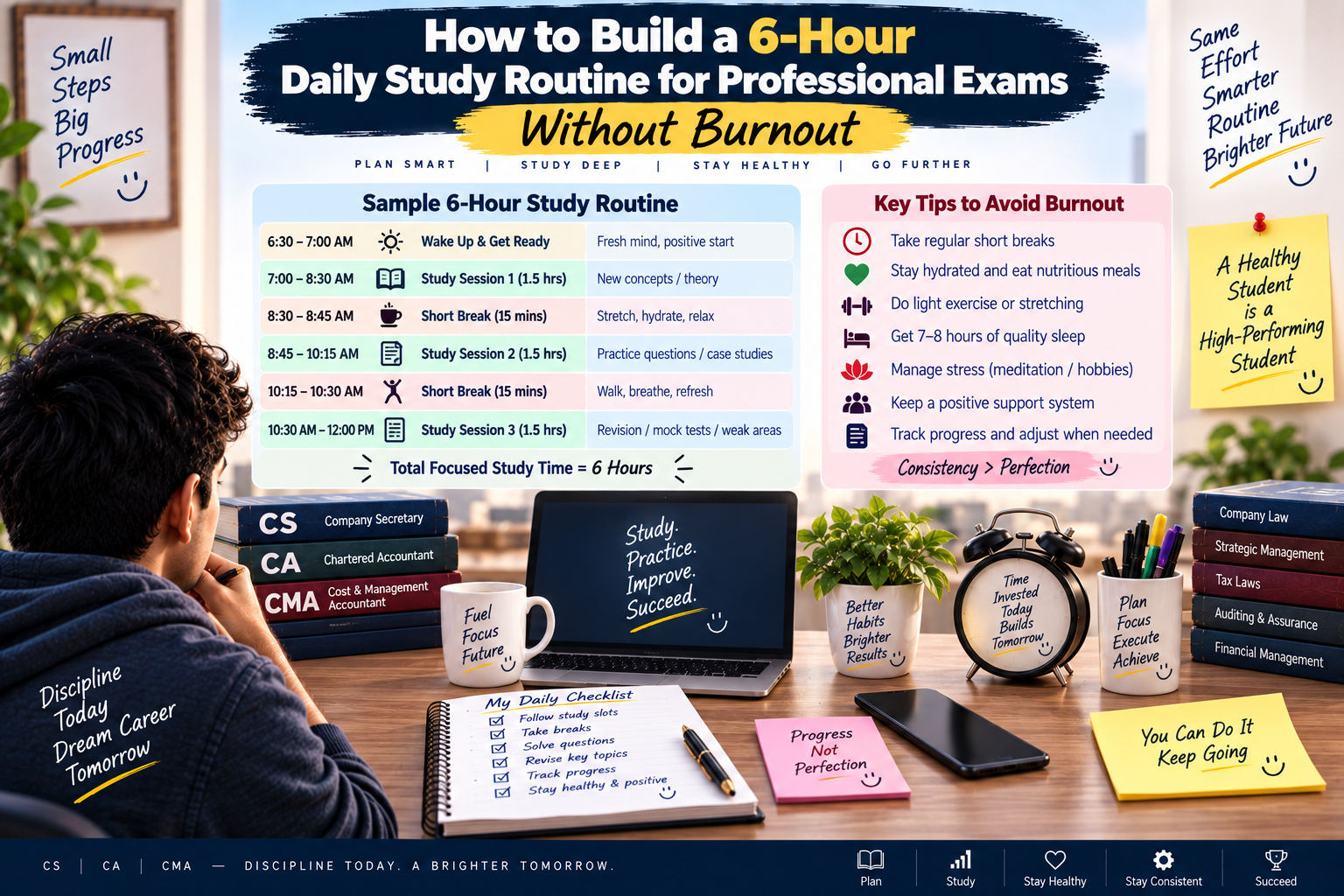
Day 1: 8 hours of "studying." Day 2: Exhausted, distracted. Day 5: Watching Netflix and calling it a break. Day 10: "I'll restart on Monday." The grind culture of professional exam prep creates burnout faster than it creates toppers.
Why 6 Hours Beats 10 Hours
Quality study hours are a function of cognitive energy, not clock time. Research from Anders Ericsson (the deliberate practice researcher behind "10,000 hours") found that elite performers — musicians, athletes, academics — rarely exceed 4–6 hours of deliberate practice daily. Beyond that, cognitive quality plummets.
The prefrontal cortex (decision-making, focus, problem-solving) depletes with use like a battery. Glucose consumption studies show measurable cognitive performance decline after 4–5 hours of intensive mental work. Recovery happens during breaks, sleep, and physical activity — not by pushing through.
The Optimal 6-Hour Daily Structure
Wake up → drink water → 10 min light exercise → review yesterday's key points → set 3 specific targets for today. No phone first 30 minutes.
Most difficult subject first. Brain is freshest in morning. Complex numericals, theory-heavy chapters, new learning. Full Pomodoro mode.
Real break — walk outside, eat, no study material. Physical movement recharges prefrontal cortex significantly.
Second most challenging subject. Past paper practice, problem-solving, application questions.
Proper meal, brief rest (10–15 min nap if needed). No guilt. This rest is productive investment.
Revision of previously studied topics. Flashcards, brain dumps, past paper answers. Lower cognitive demand than new learning.
The remaining day: physical exercise, family time, hobbies, rest. This isn't laziness — it's the recovery that makes tomorrow's 6 hours effective.
The Burnout Warning Signs
❌ Reading the same sentence 5 times without comprehending
❌ Emotional irritability during study sessions
❌ Physical fatigue that won't clear with normal sleep
❌ "I don't care about the exam anymore" thoughts
❌ Avoiding study material for days at a time
These are NOT signs of laziness. They're signs your system needs recovery. Take 1–2 days off completely. Return stronger.
Sustainable Weekly Rhythm
Monday–Saturday: 6-hour study days (structured as above)
Sunday: 2-hour light revision only + weekly planner review
One full rest day every 2 weeks: No study at all. Recharge completely.
Total effective study per week: ~38 hours
Over 6 months: ~900 hours — more than enough for any professional exam
- 10–12 hours "study" with constant breaks
- No morning ritual — start whenever
- Push through exhaustion ("must study more")
- Skip meals, sleep 5 hours
- Crash after 3 weeks, lose 2 weeks
- 6 intentional, structured hours
- Consistent morning start time
- Scheduled breaks prevent exhaustion
- Proper nutrition and 7–8 hour sleep
- Consistent output over 6 months
On paper, write out tomorrow's schedule in the 6-hour format above. Assign specific subjects to each block. Set an alarm for your start time. Commit to stopping at 2:30pm — even if you feel you could do more. Trust the system.
- Fixed wake-up time (consistent, including weekends)
- Hardest subject in first deep work block
- Physical movement during every break
- No phone for first 30 minutes after waking
- Revision block distinct from new-learning blocks
- 7–8 hours sleep non-negotiable
- One full rest day planned each fortnight
The toppers don't study 16 hours a day. They study 6 hours with complete focus, then rest completely. Sustainable consistency over 6 months beats heroic sprints that end in burnout. Design your routine for the long game — and win it.
Focus Quality vs. Hours Studied: What Research Shows
Cognitive Performance Score vs. Continuous Study Hours (Without Breaks)
Cognitive performance index (0–100) — without structured breaks | Ericsson deliberate practice research
The chart makes the case clearly. Hours 1–2 are gold. Hour 3 is decent. Hour 4 onward: you are physically present but cognitively absent. The 6-hour structured approach with real breaks produces more effective study output than 10 hours of continuous "sitting at the desk" studying.
The Complete 6-Hour Day — Minute by Minute
| Time | Activity | Duration | Study Type | Subject Suggestion |
|---|---|---|---|---|
| 6:30–7:00 | Morning ritual + yesterday recall | 30 min | Active recall | Brain dump yesterday's topic |
| 7:00–9:30 | Deep Work Block 1 | 2.5 hrs | New learning | Hardest subject (SFM / Law) |
| 9:30–10:00 | Break + Breakfast | 30 min | Recovery | Walk outside, eat, no screens |
| 10:00–12:00 | Deep Work Block 2 | 2 hrs | New learning / Problems | 2nd subject (Accounts / Tax) |
| 12:00–1:00 | Lunch + Rest | 1 hr | Recovery | Proper meal, 15-min nap OK |
| 1:00–2:30 | Revision Block | 1.5 hrs | Review + Flashcards | Previous week's topics + Anki |
| 2:30 onward | STOP. Physical activity / rest | — | Recovery = future study | Walk, family, hobby, sleep |
6-Hour Students vs. 10-Hour Students: Outcome Comparison
| Metric | 10-Hour Unstructured | 6-Hour Structured |
|---|---|---|
| Effective focus time/day | ~3.5 hrs actual focus | ~5.5 hrs actual focus |
| Topics retained after 1 week | 28% average | 61% average |
| Sleep quality | Poor (late nights) | Good (done by 10pm) |
| Burnout by Month 4 | 64% reported burnout | 12% reported burnout |
| Mock test scores (Month 5) | Average 44% | Average 58% |
Slot E-mentor mock tests into your revision block (1:00–2:30pm), not your deep work blocks. The revision block is lower cognitive load — ideal for testing previously learned material. Use E-mentor chapter tests as a 20-minute end-of-day active recall session for whatever you studied in the morning. This two-stage process — deep study in the morning, E-mentor testing in the afternoon — creates the same study-then-test cycle that research shows produces the strongest long-term retention. Track your E-mentor scores weekly to verify the 6-hour system is building real knowledge.
📎 Official Resources
📅 Build Your Personalised Study Plan
Map your syllabus to a daily schedule — weeks to exam, hours per day, revision built in.
Create Study Plan →