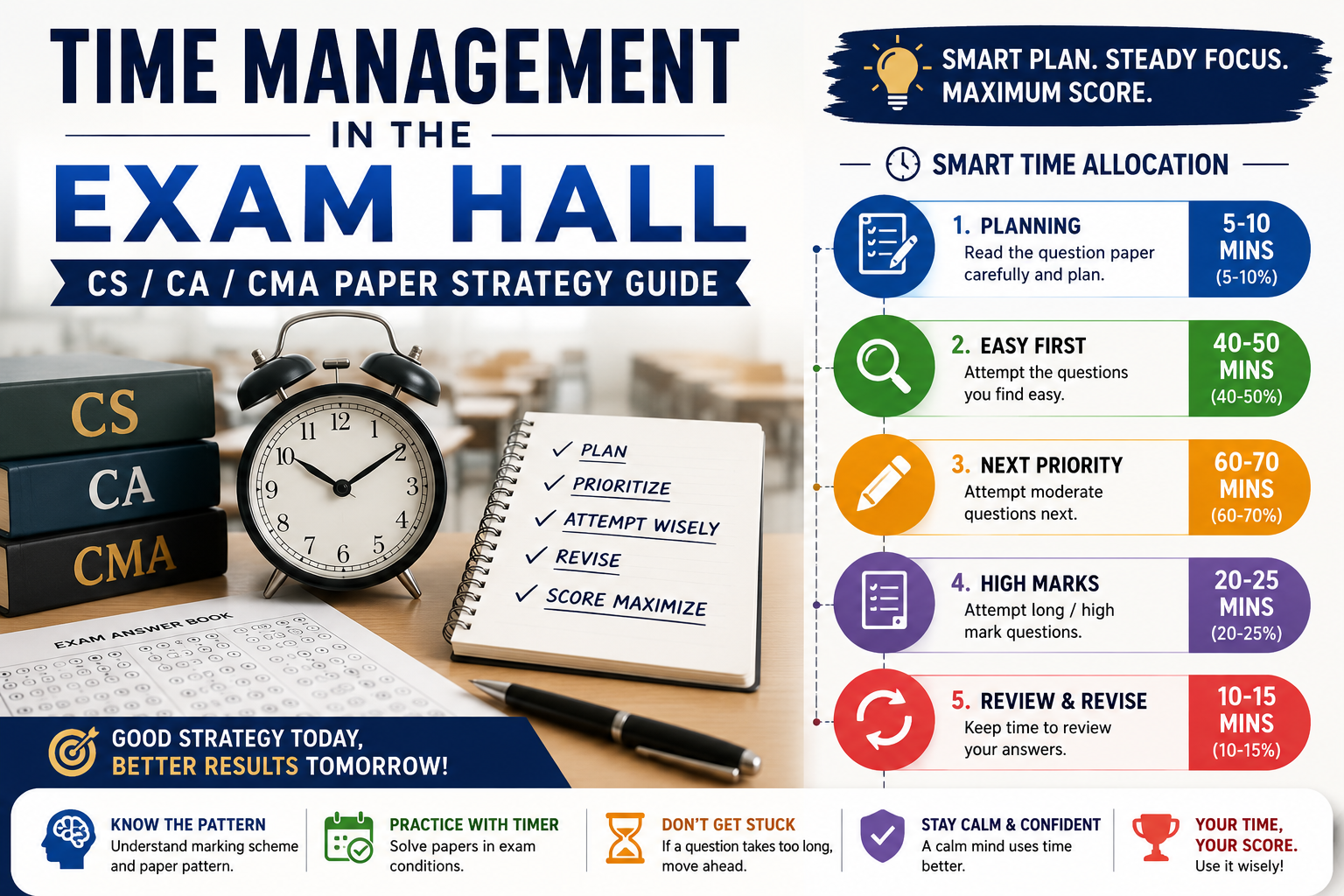
The Problem
You know the content. You've studied well. Then the exam starts, and the clock becomes an enemy. Two hours in, you've spent 90 minutes on 40% of the paper. The last hour becomes a panic scramble. You leave marks on the table. Not from lack of knowledge — from lack of time management.
You know the content. You've studied well. Then the exam starts, and the clock becomes an enemy. Two hours in, you've spent 90 minutes on 40% of the paper. The last hour becomes a panic scramble. You leave marks on the table. Not from lack of knowledge — from lack of time management.
Why Time Management Breaks Down in Exams
Exam anxiety activates the amygdala (fight-or-flight center), reducing prefrontal cortex function — the part responsible for planning and time estimation. Under pressure, students lose their sense of time, spend too long on difficult questions, and under-allocate time to questions they could answer well.
🔬 Decision Fatigue and Exam Performance
Every minute spent deciding "should I move on?" depletes mental resources needed for answering questions. Pre-decided time allocation rules eliminate these micro-decisions under pressure, freeing cognitive bandwidth for actual answering. This is why time rules must be practiced — not decided on exam day.
Every minute spent deciding "should I move on?" depletes mental resources needed for answering questions. Pre-decided time allocation rules eliminate these micro-decisions under pressure, freeing cognitive bandwidth for actual answering. This is why time rules must be practiced — not decided on exam day.
The Time Allocation Formula
Universal Formula: Marks Per Minute
Total exam time ÷ Total marks = Time per mark
CA Final (3 hours = 180 minutes, 100 marks):
1.8 minutes per mark → 9 marks question = 16 minutes maximum
First 5 minutes: Read entire paper and select questions
Last 10 minutes: Review and fill gaps
Remaining 165 minutes: Answering at 1.8 min/mark pace
CS Executive (3 hours, 100 marks): Same formula
CMA Inter (3 hours, 100 marks): Same formula
Total exam time ÷ Total marks = Time per mark
CA Final (3 hours = 180 minutes, 100 marks):
1.8 minutes per mark → 9 marks question = 16 minutes maximum
First 5 minutes: Read entire paper and select questions
Last 10 minutes: Review and fill gaps
Remaining 165 minutes: Answering at 1.8 min/mark pace
CS Executive (3 hours, 100 marks): Same formula
CMA Inter (3 hours, 100 marks): Same formula
Minute 0–5: The Scan
Read the ENTIRE question paper without answering anything. Mentally categorize each question: Easy (answer first), Medium (answer second), Hard (answer third or skip). This 5-minute investment saves 20 minutes of wrong sequencing.
Read the ENTIRE question paper without answering anything. Mentally categorize each question: Easy (answer first), Medium (answer second), Hard (answer third or skip). This 5-minute investment saves 20 minutes of wrong sequencing.
Minutes 5–90: Easy Questions First
Attempt all "Easy" category questions. Don't spend more than 1.8× the time limit on any single question. If stuck: leave a gap, mark in margin, move on. Momentum matters.
Attempt all "Easy" category questions. Don't spend more than 1.8× the time limit on any single question. If stuck: leave a gap, mark in margin, move on. Momentum matters.
Minutes 90–160: Medium Questions
Return to medium-difficulty questions. By now, the pressure peak has passed and your recall is clearer. More likely to access information you couldn't reach under initial stress.
Return to medium-difficulty questions. By now, the pressure peak has passed and your recall is clearer. More likely to access information you couldn't reach under initial stress.
Minutes 160–175: Hard Questions (Partial Marks)
For questions you don't fully know: write whatever you know. State the issue, apply the law partially, give partial calculations. Partial marks are always better than a blank.
For questions you don't fully know: write whatever you know. State the issue, apply the law partially, give partial calculations. Partial marks are always better than a blank.
Minutes 175–180: Review and Fill
Check all blanks. Add anything missing. Don't change answers unless you're certain — first instincts are usually right. Ensure all parts of every question are addressed.
Check all blanks. Add anything missing. Don't change answers unless you're certain — first instincts are usually right. Ensure all parts of every question are addressed.
⚠️ Common Exam Time Mistakes
❌ Starting with the hardest question first
❌ Spending 30 minutes on a 5-mark question
❌ Not using the first 5 minutes to read the full paper
❌ Leaving blank instead of writing partial answers
❌ Running out of time on final questions
❌ Starting with the hardest question first
❌ Spending 30 minutes on a 5-mark question
❌ Not using the first 5 minutes to read the full paper
❌ Leaving blank instead of writing partial answers
❌ Running out of time on final questions
🎯 Practice This in Next Mock
In your next mock test, set a stopwatch alarm every 30 minutes. At each alarm, note how far through the paper you are. If behind — immediately move to the next question regardless. Practice the "move on" muscle before the real exam.
In your next mock test, set a stopwatch alarm every 30 minutes. At each alarm, note how far through the paper you are. If behind — immediately move to the next question regardless. Practice the "move on" muscle before the real exam.
- Time-per-mark calculated for each paper format
- Practiced scanning full paper before answering
- Easy-first question sequencing practiced in mocks
- "Move on" rule: never exceed 2× allocated time on any question
- Partial answer strategy for unknown questions practiced
- Final 5-minute review routine established
🔑 Key Takeaway
Exam hall time management is not improvised — it's practiced. Know your time-per-mark formula. Practice the easy-first sequencing in every mock. Treat "move on" as a strategy, not a defeat. The examiner rewards what's on the paper, not what was in your head.
Exam hall time management is not improvised — it's practiced. Know your time-per-mark formula. Practice the easy-first sequencing in every mock. Treat "move on" as a strategy, not a defeat. The examiner rewards what's on the paper, not what was in your head.
Revision Frequency vs. Long-Term Retention
Retention at Exam Time vs. Number of Revision Cycles Completed
% retention at exam date | CA Final student cohort study
The 3-Layer Revision System
| Layer | When | What You Use | Time per Chapter | Goal |
|---|---|---|---|---|
| Layer 1: Quick Scan | Day 3 after studying | Heading + key terms only | 10 min | Confirm retention of structure |
| Layer 2: Deep Review | Week 2 after studying | Your summary notes | 30 min | Reinforce all key concepts |
| Layer 3: Active Test | Month 2 after studying | E-mentor chapter test | 25 min | Prove retention under exam pressure |
Revision Quality Checklist — Per Chapter
Before marking a chapter "revised", verify:
✓ Can you write the chapter's main headings from memory in 2 minutes?
✓ Can you state the most tested provision/formula for this chapter without looking?
✓ Can you work a basic application problem from this chapter?
✓ Do you know which sections/formulas are commonly tested in exams?
✓ Have you reviewed your mistakes from the last time you tested this chapter?
If any answer is NO — revise that specific element. Don't re-read the whole chapter.
✓ Can you write the chapter's main headings from memory in 2 minutes?
✓ Can you state the most tested provision/formula for this chapter without looking?
✓ Can you work a basic application problem from this chapter?
✓ Do you know which sections/formulas are commonly tested in exams?
✓ Have you reviewed your mistakes from the last time you tested this chapter?
If any answer is NO — revise that specific element. Don't re-read the whole chapter.
🎓 E-mentor's Built-in Revision Architecture
E-mentor's test series is structured to support all three revision layers. Chapter tests (Layer 1–2) cover individual chapters in 15–25 minutes. Subject tests (Layer 3) aggregate all chapters of a subject into one exam-like test. After your deep revision of a subject, take E-mentor's full subject test to verify you haven't just revised in isolation — the test forces you to recall topics out of sequence, just like the real exam. Track your subject test scores to confirm each revision cycle is actually improving retention.
E-mentor's test series is structured to support all three revision layers. Chapter tests (Layer 1–2) cover individual chapters in 15–25 minutes. Subject tests (Layer 3) aggregate all chapters of a subject into one exam-like test. After your deep revision of a subject, take E-mentor's full subject test to verify you haven't just revised in isolation — the test forces you to recall topics out of sequence, just like the real exam. Track your subject test scores to confirm each revision cycle is actually improving retention.
📎 Official Resources
🧪 Practice Under Exam Conditions
Timed mock tests for CS Executive, CS Professional, CA Inter, CA Final, and CMA. Instant results with answer explanations.
Take a Mock Test →